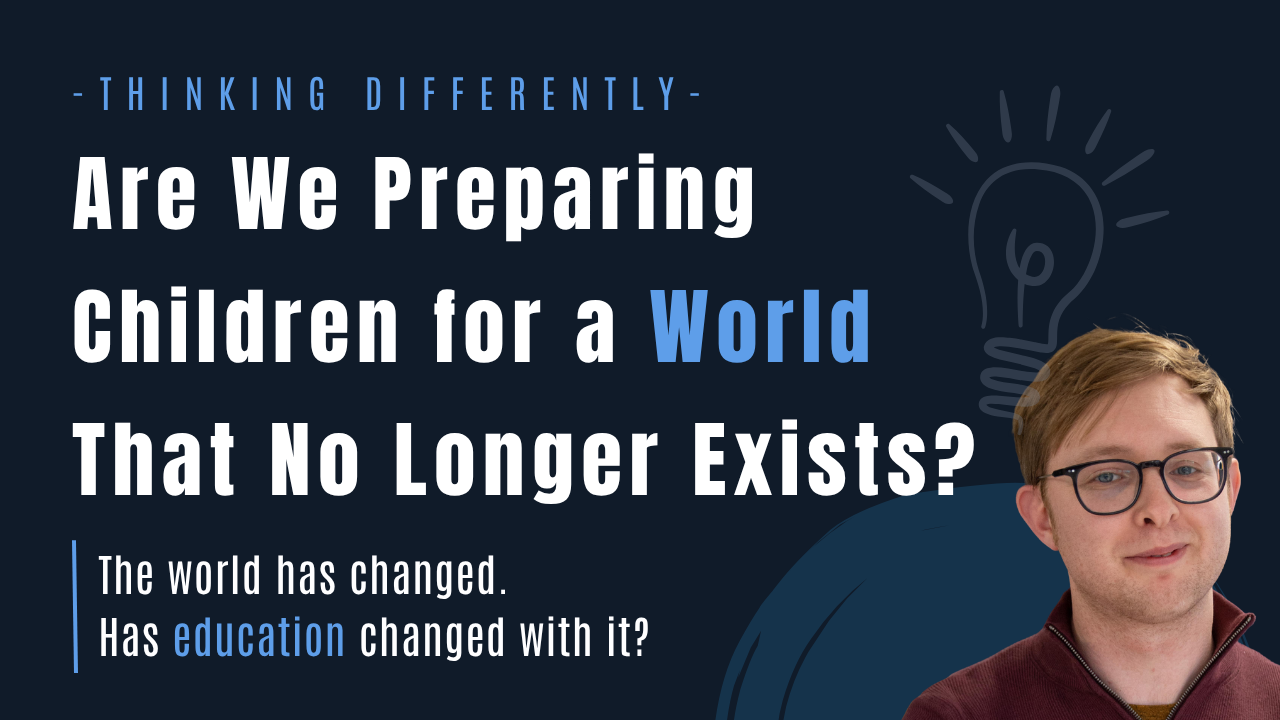
Are We Preparing Children for a World That No Longer Exists?
 By Jason Sharpe • August 16, 2026
"The future is already here. It’s just not evenly distributed." William Gibson
There was a time when the purpose of education seemed obvious. Children went to school to acquire knowledge, pass examinations and secure a good job. The formula was simple. Study hard, gain qualifications and your future would largely take care of itself.
For generations, that model served society remarkably well. Schools prepared young people for an industrial and later an information economy where knowledge was scarce, expertise was highly valued, and qualifications opened doors, but something fundamental has changed. We are now preparing children for a world that is disappearing faster than our education system can adapt. The question is no longer whether artificial intelligence will change the workplace. It already has. The real question is whether education is changing quickly enough to prepare young people for the world they will actually inherit.
A World Built on Information
For most of modern history, information was power. Teachers held it. Books contained it. Universities protected it. Success often depended on how much information you could remember and reproduce. This shaped education itself. Lessons focused on acquiring knowledge. Examinations rewarded recall. Homework reinforced repetition. That made perfect sense.
When information was difficult to access, helping children remember it was incredibly valuable. Today, every child carries more information in their pocket than entire libraries once contained. Artificial intelligence can explain complex ideas, translate languages, solve mathematical problems and summarise entire books within seconds. Information is no longer scarce; it is abundant, and abundance changes value. Just as calculators changed what it meant to be good at arithmetic, AI is changing what it means to be educated. The challenge is no longer simply accessing information but knowing how to evaluate it, question it and apply it wisely.
Knowledge Still Matters
Whenever conversations like this begin, somebody inevitably asks the same question. "So are you saying knowledge doesn't matter anymore?" Absolutely not. Knowledge matters enormously. You cannot think critically about subjects you know nothing about, solve problems without understanding them or challenge misinformation without a foundation of genuine understanding. English, mathematics, science, history and the arts remain essential.
The issue is not that knowledge has become less important; it's that knowledge alone is no longer enough. We are educating children for a world where knowing something was once the competitive advantage. Increasingly, the advantage lies elsewhere.
The Rise of Human Skills
If AI can produce essays, generate presentations, write code, summarise research and answer factual questions in seconds, what becomes uniquely human? Ironically, the skills we sometimes describe as "soft skills" may prove to be the hardest to replace. Confidence, judgement, curiosity, creativity, communication, resilience, empathy, adaptability and decision-making. These are not optional extras. They are becoming the very qualities that distinguish human contribution from machine capability. Governments, employers and education organisations are increasingly arguing that adaptability, resilience, critical thinking and judgement are becoming central to future success alongside strong academic foundations. Perhaps we have spent decades treating these as desirable outcomes rather than essential ones.
The Careers We Cannot Yet Imagine
Consider a child beginning secondary school this September. They may not enter full-time employment for another eight or ten years. Many of the roles they eventually perform may not yet exist. Others will be transformed beyond recognition. Research suggests that a significant proportion of today's jobs will change over the coming years as AI reshapes industries and workflows.
How do you prepare someone for a future that cannot be predicted? Certainly not by teaching them a fixed set of answers. You prepare them by helping them become adaptable learners. People who know how to think, how to question, recover from failure, learn continuously and navigate uncertainty. Perhaps the most important qualification our children will ever gain is the ability to keep learning long after formal education ends.
We Have Mistaken Preparation for Prediction
Education often assumes we can predict the future. Choose the right GCSEs, A Levels, degree and career. But the future has become increasingly unpredictable. Instead of preparing children for one pathway, perhaps we should prepare them for many. Instead of asking, "What job do you want?" Perhaps we should ask, "What kind of person do you want to become?" That question changes everything, because careers, technology, and industries will change. Character endures.
Confidence Is Becoming a Competitive Advantage
One lesson I have learnt through working with hundreds of young people is this: Many do not struggle because they lack ability. They struggle because they no longer believe in themselves. Confidence is not simply feeling good. It influences whether a young person attempts something difficult, recovers after failure, asks for help, embraces opportunity or perseveres. In an increasingly uncertain world, confidence may become one of the most valuable forms of preparation we can give a child.
The Schools of Tomorrow
None of this means schools have failed. Far from it. Teachers continue to perform one of society's most important roles, but education has always evolved. Schools once prepared children for factories. Later they prepared them for offices. Now they must prepare them for a world where routine cognitive tasks are increasingly shared with intelligent machines.
This doesn't diminish teachers; it elevates their role. As technology becomes more capable of delivering information, the human elements of education become even more valuable. Relationships, encouragement, challenge, curiosity, belonging and purpose. Perhaps the teacher of the future becomes less of a distributor of knowledge and more of a developer of human potential.
What Should We Teach?
If I could redesign education tomorrow, I would not remove English, Mathematics or science. I would place something alongside them: confidence, communication, decision-making, financial understanding, emotional resilience, organisation, purpose and critical thinking. Not because these are more important than academic subjects, but because they enable young people to use everything else they learn. Knowledge opens doors. Character determines whether we walk through them.
Life Beyond School
Over recent months, I have found myself asking a simple question: Schools prepare children for exams. Who prepares them for life? That question eventually led me to develop Life Ready Mentoring.
Not because schools are getting it wrong, but because I increasingly believe young people need something alongside academic education. A place to explore confidence, identity, purpose and decision-making. The practical and emotional skills that help them navigate adulthood. Life Ready is not about replacing education. It complements it, because education should never be reduced to examination performance alone. Its purpose has always been much greater than that.
The Future We Cannot See
Every generation prepares the next for the future it imagines. The challenge facing ours is that the future is changing faster than ever before. Perhaps that means we need to stop asking, "What information should children remember?" And start asking, "What kind of adults do we hope they become?" Because ultimately, education has never been about producing better examination candidates. It has always been about developing thoughtful, capable, compassionate human beings. The world our children inherit will almost certainly look different from the one we grew up in. The question is whether our education system will help them adapt to it, or continue preparing them for a world that no longer exists.